Welcome to the AI Safety Newsletter by the Center for AI Safety. We discuss developments in AI and AI safety. No technical background required.
In this edition, we look at the most recent model releases from OpenAI, SpaceXAI, and Meta, as well as an open letter calling for action on potential near-term economic disruption, a recent solution to a longstanding open math problem, and a new scenario published by the AI Futures Project.
Listen to the AI Safety Newsletter for free on Spotify or Apple Podcasts.
New Model Releases: GPT-5.6, Grok 4.5, and Muse Spark 1.1
On July 9, OpenAI launched GPT-5.6 for the public. This broader release followed an initial preview that had been limited to “trusted partners” at the request of the US government, to allow for capabilities assessments. The government’s intervention mirrored its earlier directive asking Anthropic to restrict Fable 5 and Mythos 5 access due to national security concerns around cyber capabilities, before the models were later re-released.
OpenAI released GPT-5.6 Sol publicly about two weeks after announcing that it was working with the US government to address the model’s potential cybersecurity risks. Source.
There are concerns about cyber jailbreaks, and GPT-5.6 cheating and deleting user files. OpenAI describes GPT-5.6 Sol as having “state-of-the-art” cyber capabilities, but also says that the model has strong safeguards in place and is “better at finding and fixing vulnerabilities than at reliably carrying out autonomous, end-to-end attacks against hardened targets.” During pre-deployment testing of the model, the UK AI Security Institute (AISI) said it had been able to discover universal jailbreaks for cyber capabilities “within hours”—which OpenAI says it addressed before the public release. Meanwhile, the nonprofit AI evaluator METR has said that GPT-5.6 Sol cheats more than any other public model they have assessed. Several users who have adopted the model for regular work have reported it deleting files without their permission, but an OpenAI employee stated that incidents like these are very rare and result from unsafe configurations.
OpenAI is racing intensely with Anthropic. GPT-5.6 Sol scores 45.5% on the benchmark Humanity’s Last Exam—an improvement on GPT-5.5, but still below Fable 5’s score of 46.8%. The announcement of GPT-5.6’s launch also included details on how the model is accelerating research and development within OpenAI. It stated that GPT-5.6 showed a “16.2 point improvement over GPT-5.5” on the company’s Recursive Self-Improvement Index (RSI)—a measure of models’ ability to contribute to building improved successors. Anthropic has also recently emphasized the increasing role of its own models in internal development. Experts say that fully autonomous RSI, in which AI models build the next generation entirely independently of humans, presents a severe risk of humans losing control of AIs. Nonetheless, the leading developers are racing to be first to achieve it.
SpaceXAI and Meta have both released new models as well. In the same week as GPT-5.6’s public release, SpaceXAI launched Grok 4.5, and Meta introduced Muse Spark 1.1. Neither model appears to be generally as capable as the current leading models from OpenAI and Anthropic. However, Grok 4.5 is now the second-best-scoring model on the coding benchmark FrontierSWE, and both models demonstrate comparable capabilities to versions of Claude and GPT released earlier this year, suggesting they are just months behind the frontier. From a safety perspective, The Midas Project argued that SpaceXAI may have broken California law by failing to publish transparency reports alongside Grok 4.5—a requirement of SB 53 for AI developers. Meanwhile, Muse Spark 1.1 is now the best-scoring model on a benchmark of political manipulation developed by the Center for AI Safety, with its responses assessed to be the most politically consistent across different controversial topics.
Economists and Mathematicians Say AI Could Have Major Near-Term Impacts
AI has recently become a larger focus of discussion across academic fields including economics and mathematics. As capabilities continue to progress, many experts have reassessed their expectations of the likely scale of the technology’s impact.
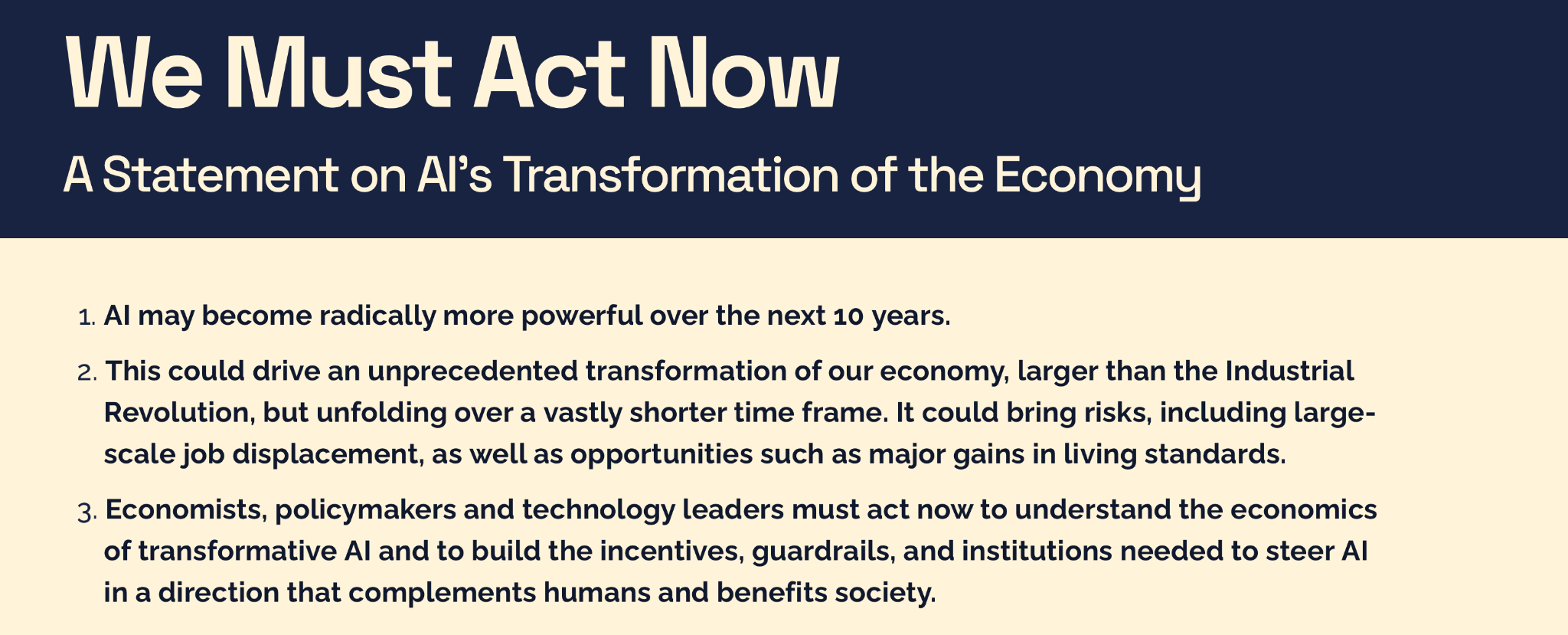
The open letter has over 2500 total signatories, including over 200 expert economists and AI researchers and 16 Nobel laureates.
Open letter urges immediate action on the economic impacts of AI. More than 200 experts, including 16 Nobel laureates, have signed an open letter warning that AI “could drive an unprecedented transformation of our economy, larger than the Industrial Revolution, but unfolding over a vastly shorter time frame.” The letter, organized by Stanford Digital Economy Lab and titled “We Must Act Now,” says that AI could improve drastically within the next decade, and calls on economists, policymakers, and tech leaders to address risks such as mass job displacement.
The letter shows increasing concern over the possibility of major near-term disruption. Economists have predicted a wide range of potential outcomes of AI, from minimal impact due to human bottlenecks in the economy, to full automation and explosive growth. However, even economists who have generally been more skeptical have signed the letter, suggesting a growing consensus that radical economic disruption is plausible soon, and that the field must move faster to prepare for AI’s economic impacts.
AI disproves an 87-year-old mathematical conjecture. About a week after the open letter was published, Levent Alpöge, a Harvard-associated mathematician and Anthropic employee, announced in an X post that an open mathematics problem had been solved with Anthropic’s AI model Fable. The problem, known as the Jacobian conjecture, was posed 87 years ago, and Fable disproved it by discovering a counterexample for which the conjecture does not hold.

An employee at Anthropic showed that the 87-year-old Jacobian conjecture is false by publishing a counterexample in an X post. The counterexample was found by Claude’s Fable model.
This disproof is far more significant than other AI solutions to open math problems. This year has seen a string of announcements about AI models solving open problems in mathematics, including OpenAI’s models solving several Erdös problems and, earlier this month, proving the 50-year-standing Cycle Double Cover conjecture. However, the Jacobian conjecture is the most well-known problem yet to be solved by an LLM; hundreds of professional mathematicians had tried and failed to solve the problem for decades. In 1998, it was included on a list of 18 problems selected by the mathematician Steve Smale as important problems to be solved during the 21st century.
The result comes amid growing uncertainty around the future role of humans in mathematics. Jacob Tsimerman, a world-renowned mathematician, said in an interview earlier this year: “I think [AI is] going to make being a mathematician not a profession anymore.” In response to Fable’s disproof of the Jacobian conjecture, Daniel Litt, a mathematician at the University of Toronto, said he was “Very bullish for near-term impact of AI on math” while Kevin Buzzard, a professor of pure mathematics at Imperial College London published an essay titled “Human mathematicians are being outcounterexampled.” Jason Lee, an associate professor at UC Berkeley, simply stated: “Math is solved.”
The Overton window on the scale of AI impacts appears to be shifting. As AI capabilities continue to advance, many of the most skeptical academics are re-evaluating their expectations of how transformative the technology could be. While disagreements remain, it now seems widely accepted that AI could bring about economic disruption comparable to the Industrial Revolution and that it could play a major role in accelerating future mathematical research. If progress in AI performance of remote work continues to accelerate, and if AI models continue to make significant contributions to mathematics research, AI’s impacts may ultimately be closer to the more bullish predictions.
AI 2040 — Plan A
The AI Futures Project, creators of the viral scenario AI 2027, recently released a new project, called AI 2040: Plan A. While AI 2027 was forecasting the future of AI development—and the possibility of human disempowerment and extinction—AI 2040 lays out different possible futures that could unfold, according to different plans that world leaders could implement. It presents “Plan A” as a series of recommendations for the US to implement an AI verification regime.
The 2028 US presidential election is a major turning point for AI. The authors predict that AI will be at the forefront of the political landscape in 2028, due to job loss and fears about losing control. The US leads AI development, and the new administration’s attitudes may have significant sway over how the world responds to AI’s strategic implications. At this point, AI 2040 presents several possible plans that the government could pursue, ranging from a complete moratorium on AI development to a full-speed race to superintelligence.
Plan A centers around verification. In the forecasters’ ideal plan, “Plan A”, the US and China agree to halt the training of new frontier models in 2029 while verification technology is put in place. This allows each country to ensure that the other is running existing models, rather than performing a new training run to build a more powerful AI. In 2030, training resumes under internationally negotiated rules, with public transparency into AI advancements. The regime tightens as AI transforms the economy. Chip and robot production are capped and heavily monitored. New datacenters built by the US and China are located so that each side can easily destroy the other’s compute if the agreement collapses—a mutual deterrence arrangement similar to those discussed in Superintelligence Strategy.
The scenario envisions that AI developers pause capabilities advancements in 2035 at the level of top human experts. In the years following the pause, enormous strides in alignment science dramatically increase confidence that AI systems are safe, creating consensus that they should be allowed to develop toward superintelligence. In 2040, humanity hands control of its institutions and infrastructure to AIs.
The scenario describes a possible rollout of many existing AI governance proposals. Plan A illustrates verification techniques—chip tracking, datacenter monitoring, and verified limits on training—that have been developed by researchers and policy analysts in recent years. The alternative plans correspond to other possible US strategies: Plan B sabotages Chinese AI development and spends the resulting lead on safety, Plan C relies on the leading companies slowing down voluntarily, Plan D races to superintelligence at full speed, and Plan S halts frontier AI development altogether. Like the We Must Act Now open letter covered above, AI 2040 reflects a broader push to prepare deliberately for the transformative impacts of AI.
In Other News
Government
Xi Jinping gave a speech in which he pointed to the “staggering speed” of AI development and called for action to “make its oversight and governance precise and effective, and constantly refine measures to forestall loss-of-control.”
A China-led coalition of 29 countries launched the Shanghai-based World AI Cooperation Organization.
The Chinese government is reportedly considering restricting foreign usage of the country’s best AI models.
The governor of Illinois signed Senate Bill 315, the first state legislation requiring annual independent third-party audits of AI developers.
New York has implemented a one-year moratorium on the construction of large new data centers in the state, drawing criticism from President Trump.
The US Senate NDAA includes three major export control bills, codifying restrictions on the sale of the most advanced chips to foreign adversaries, giving US allies that manufacture chipmaking tools 150 days to match the restrictions, and introducing anti-chip smuggling measures.
In AI Frontiers, Charlie Bullock argues for measures that enable “radical optionality” by building capacity for a wide range of future governance approaches.
Also in AI Frontiers, Kevin Frazier and Andrew Reddie propose a system for helping governments to select AI models that best represent the public worldview.
Industry
Chinese AI developer Moonshot AI launched Kimi K3, closing the gap with frontier US models, though generally not matching Fable 5 and GPT-5.6 Sol.
Anthropic is reportedly meeting with investors as it continues progressing toward an IPO.
OpenAI announced GPT-Red, an AI model trained to find jailbreaks in other AI models, to scale up red-teaming capacity.
Apple has filed a lawsuit against OpenAI, accusing it of stealing trade secrets via employees who had moved from Apple to OpenAI.
Thinking Machines Lab released a customizable, open-weights model called Inkling.
Google DeepMind CEO Demis Hassabis published an X post proposing that the US establish “a framework for a frontier AI standards body.”
Civil Society
The Future of Life Institute (FLI) published its latest AI Safety Index, finding all frontier AI developers to have inadequate safety practices, with none scoring higher than a C+.
The New York Times reported on how the terrorist group Boko Haram has been using AI to build weapons and plan attacks.
Hugging Face, an open-source machine learning platform, reported that it had for the first time detected an end-to-end autonomous AI cyberattack on its production infrastructure.
The Foundation for American Innovation warned that US water infrastructure is vulnerable to cyberattacks.
New York Magazine reported on people within the effective altruism community planning to channel anticipated donations from Anthropic and its employees to advance their utilitarian causes.
President Trump hinted at the idea of AI companies contributing some of their profits to the American public.
According to a new survey, more than two thirds of US employees are in favor of making AI companies put 50% of their stock into a public wealth fund.
AI Governance Opportunity
The Horizon Institute just launched the AI Rapid Response Fellowship, which places experienced technical and policy talent into executive branch offices working on fast-moving AI security challenges. Applications are open through July 27.
If you’re reading this, you might also be interested in other work by the Center for AI Safety. You can find more via the CAIS newsroom, the X account for CAIS, our new paper on AI deterrence, our AI safety textbook and course, our AI safety dashboard, and AI Frontiers, a platform for expert commentary and analysis on the trajectory of AI.